Showing posts with label globalization. Show all posts

Saturday, April 27, 2013

More Free Traitor Nonsense: "The Manufacturing Jobs We've Lost Weren't Good Jobs Anyway"

A popular meme put forth by people who feel America benefits by closing factories and putting Americans out of work, is that we don't need those jobs anyway. Or worse, they are bad jobs and we should get rid of them.

Case in point:


Lost Manufacturing Jobs: Good Riddance?
There is no question that the U.S. has lost an enormous number of manufacturing jobs to lower wage countries.  These countries include mega economies like China and a number of smaller countries such as Vietnam that have large numbers of workers willing to work for low wages. Given the current high unemployment rate in the United States, it is understandable that politicians point out that we need to regain manufacturing jobs and that the loss of jobs to other countries is a major problem for the U.S.
But before we accept the loss of many low skilled manufacturing jobs as a major negative for the U.S. and that it should be halted and perhaps even reversed, it is important to put it in the context of what we know about the social impact of simple, repetitive work.  The fact is that this type of work often has numerous negative impacts on both individuals and society in general. This was highlighted recently by the news about riots taking place in Foxconn’s Chinese factories.
Even in China, low wage repetitive work can create major conflicts between workers and corporations and be destructive to society. We learned this long ago in the U.S. and it resulted in major U.S. corporations offshoring repetitive, manufacturing work or upgrading it through technology to the point where it became skilled work. In terms of social sustainability, repetitive low skilled work is a major negative. It causes employee dissatisfaction and turnover, stress-related mental and physical health problems, dysfunctional union/management relationships and large social class differences in wealth.
The bottom line is that instead of complaining about offshoring manufacturing jobs, we should be focusing on keeping and creating the right kind of manufacturing jobs. What kinds of jobs are those? In essence, I am talking about the kind of knowledge work jobs that exist in the high-tech world and the advanced manufacturing plants of some major manufacturers. We can only keep these jobs in the U.S. if we have a skilled workforce who can meet the challenges that knowledge, information technology, and engineering present.

When you hear these arguments, remember there are two obvious fatal flaws in this argument that you probably already know, but haven't been able to point out clearly before:

1) The knowledge economy that these guys talk about, is inherently too small. So is advanced manufacturing. The number of jobs that these fields will produce are high-paying and we do need them as part of our economy and industrial base, but the inherent reality of both advanced knowledge-based jobs and advanced manufacturing is that they are high productivity jobs. Knowledge-based and high-tech manufacturing industries are inherently designed to employ fewer people to do the same amount of work. Take a look around you. How many innovation-based jobs and advanced manufacturing jobs are there? How many people are out of work? The enormous ratio of unemployed people to "advanced" jobs ratio is one that is not going to change by much even in the best of times. These jobs are tragically insufficient in numbers to cover even the people who were put out of work from regular manufacturing by foreign outsourcing.

Simply put there will never be as many of these knowledge based jobs or high tech manufacturing jobs to cover the number of people thrown out of work when we send the lower end manufacturing jobs overseas. Period. No economist can hope to keep a straight face and tell you otherwise. 

The other thing you will want to remind someone of when they spout these stupid arguments is that we already have tons of college graduates in the Science, Technology, Engineering and Math (STEM) industries out there right now, and they cannot find work in the STEM fields. Consider a man who holds a Ph D in plasma physics - not even he can get a job in this so-called knowledge based economy. 

Consider these statistics, too:
There are 101,000 U.S.-born individuals with engineering degrees who are unemployed.
There are an additional 244,000 U.S.-born individuals under age 65 who have a degree in engineering but who are not in the labor market. This means they are not working nor are they looking for work, and are therefore not counted as unemployed.
In addition to those unemployed and out of the labor force, there are an additional 1.47 million U.S.-born individuals who report they have an engineering degree and have a job, but do not work as engineers.
President Obama specifically used the words “highly skilled.” In 2010, there were 25,000 unemployed U.S.-born individuals with engineering degrees who have a Master’s or Ph.D. and another 68,000 with advanced degrees not in the labor force. There were also 489,000 U.S.-born individuals with graduate degrees who were working, but not as engineers.
If knowledge based jobs are the next big thing then why do we have so many knowledge workers who are unemployed or not even working in the STEM industry?

This is where free traitors retreat to their last resort: bigotry against American workers. "They're all incompetent!" 

2) We're already shipping knowledge work overseas. Biotech has research already moved overseas. Intel has moved a major research center to China. And let's not mention the devastation that foreign outsourcing is inflicting upon the knowledge jobs of the tech industry.

The problem with globalization is that knowledge work - innovation and research - is as easily mobile as manufacturing. It doesn't matter if you have a Ph D - someone in India could have a Ph D, too, and do the same work for pennies to your dollar. Free traitors like to avoid discussing this. Remember to hammer them about it. Mercilessly.

3) China faces unrest not because manufacturing jobs are inherently jobs where workers get abused, but because China, unlike the United States, still allows rampant abuse, overworking and underpayment of their workers. America had beaten this problem of worker abuse with workplace safety laws and wage laws, to name a few basic rights that Chinese workers don't have. In China they put you in a dorm and wake you up at random in order to fulfill a company's emergency order for a new product. They can't get away with that in America.

As for the "dissatisfaction and turnover, stress-related mental and physical health problems" - all of which are less severe in American manufacturing jobs, mind you (thank labor unions for that) - there is one other point to consider: does this genius of an author think unemployment causes less of this?

4) Knowledge based jobs and high-tech manufacturing jobs require workers with college degrees. Anyone who tells you otherwise is blowing smoke out their butts. Has this author looked outside for a second to see what the cost of such degrees are, nowadays?

So the plan here is for unemployed American manufacturing workers to run the gauntlet of high tuition costs and massive student debt to get a STEM based degree to compete with the other STEM grads out there who are unemployed and looking for work. And to compete with cheap STEM labor from other countries, too. 

What could possibly go wrong with that?

Tuesday, April 2, 2013

Do you feel like humiliating a FREE TRADER globalist today? Then ask them these questions


Dear Free Traders,
Riddle me this, riddle me that…
Do you think it’s better for millions of Americans to be perpetually unemployed than to bring back the factory jobs or call center jobs they used to work in?
iPads sold in America should be made in China and not America because of what now… help me out here… phobia of China, or phobia of American workers?
America is supposed to run a $500 billion trade deficit? Why doesn’t any other country want to run that kind of deficit?
Japan is negotiating a 1,000% tariff on rice for the Trans-Pacific Partnership trade agreement, but you think America should not ever raise tariffs?
Which one of you foreign outsourcing advocates out there have ever had your call center or factory job shipped overseas?
What’s going to happen to those poor people in the third world when America’s economy collapses from all this unemployment and we can’t buy their stuff anymore? Any answers for that?
Have you ever told an unemployed American to their face that losing their job to China, Mexico or India was good for them, or the economy?
You say we’re ditching factory jobs in favor of knowledge jobs. Where are these knowledge jobs? How many knowledge job openings are there? How many unemployed are there? Compare the numbers and please explain how that knowledge-based economy is coming along. While you’re at it, would you care to explain why so many research and development jobs are going to India and China despite a glut of Science,  Tech, Engineering and Math graduates here in America?
So you say that opponents of foreign outsourcing are xenophobes. Considering that international trade is a mostly one-way street vacuuming jobs out of the United States, why should YOU not be called out as an America-phobe?
Please name one other nation on Earth that is foolish enough to outsource as much work as America does. Per capita, even.
Have a nice day.

Sunday, March 17, 2013

The Depression, Globalization and the Smoot-Hawley Tariff Myths: Something to Think About


It has been argued that the Smoot-Hawley series of tariffs did enormous damage to the economy during the Great Depression. The pro-globalist interpretation of the historical facts is that because America imposed massive tariffs, and other nations retaliated, this led to serious damage to the economy.According to the pro-globalist story, Smoot-Hawley caused, or exacerbated, the Great Depression because it severely impaired global trade.
The problem is, factually, this is simply not true.
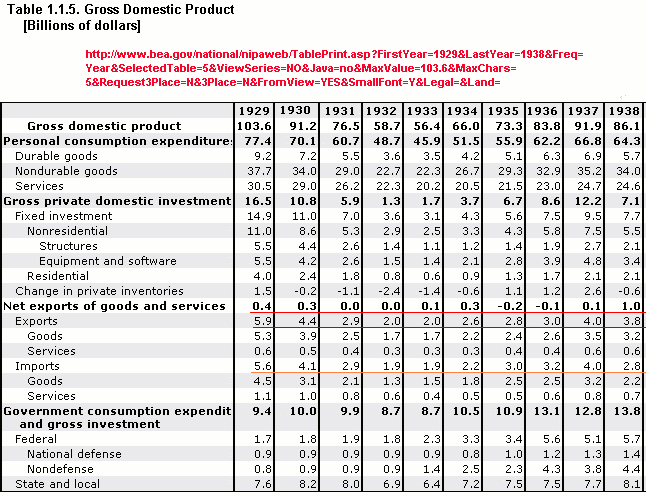
1) The nation’s GDP fell by almost half (46%) - and this affected international trade, not the other way around. We lost jobs, people stopped producing, and what little we produced, was being consumed here. And with other nations suffering as badly or worse than we were, they were in no position to buy anything from us. Which meant that their retaliatory tariffs were redundant when it comes to their effect upon trade. International trade was hindered because whole nations’ economies took a nosedive. Not the other way around.
2) There is another factor that pro-globalists do not consider when arguing that Smoot-Hawley caused (or exacerbated) the Depression. This factor is almost never even brought up by anti-globalists. History shows that when Smoot-Hawley was passed, the United States was not running the kind of monster $250 billion annual non-oil ($500 billion with oil imports) trade deficit that we are running today. The United States, at the time, was running a slight trade surplus for most of the Depression yearsThink about it. Exporting goods generates more domestic jobs, and better-paying domestic jobs, than importing goods. If you pass massive across-the-board tariffs when you are exporting more goods than you are importing, and everyone else retaliates, you stand to lose your net export activity. You stand to suffer a net loss of jobs.IN THEORY; this did not really happen in the Great Depression because the jobs had already disappeared. Now, if you are importing far more than you export, you stand to lose imports - and you also stand to end a situation where domestic factories are closing down to move overseas.
If Smoot-Hawley was ever going to do even the slightest harm to the United States economy, the only time it would ever do so is if the United States is running a trade surplus: that means, Smoot-Hawley can only ever hurt the economy if we are exporting more than we are importing. Again, that is not the case today. We are importing more than we are exporting, and we are bleeding jobs out of the country as a result.
Ever wonder why China has succeeded so well? They slapped heavy tariffs on American products, for one. They also devalued their currency, for two. South Africa is also raising other, de facto trade barriers (“buy local”), and it’s working marvelously for themYet globalists say that trade barriers won’t work for America?
3) Finally, there is one last factor that the pro-globalists are wrong about: none of the anti-globalists are calling for an across the board shutdown of imports that Smoot-Hawley was aiming for. What we want is to reduce the trade deficit to zero. America runs the largest trade deficit of any country in the world, and we run a net trade deficit with almost every major country in the world. We are bleeding out more jobs than any other nation in the world. A $250 billion non-oil trade deficit is deadly, and it is most certainly unsustainable. Trade deficits like what America is running, have a direct impact on the national debt - $250 billion (much less $500 billion) annual trade deficits make the national debt grow. And you cannot stop this type of debt growth by cutting domestic spending. Moreover, trade deficits of the magnitude that America is running, also devalue the United States dollar.
Here is the ultimate reality that pro-globalists do not want to discuss.These trade deficits will end. There is getting around this. They will end. The question is whether they end with laws that act to balance out trade, or they end when the deficits destroy our economy - and all the other economies (such as China) that depend on exports to America.
There’s only so far an economy can go by bleeding another nation’s working class of their jobs.

Wednesday, February 6, 2013

So you can't badmouth China or they ban you and your work.

The enemy in the 2012 remake of Red Dawn was changed from China to North Korea, because otherwise the film wouldn't have been allowed in China. And this is not the only such example. The new Iron Man movie, it turns out, won't use a Chinese actor for the villain known as Mandarin, because it would get the movie banned in China. 

In short: China's censorship tactics are dictating what we Americans get to see. 

Why, exactly, do we trade with these guys again? Why do we let them run all over us? 

Monday, February 4, 2013

Say NO!!! To Globalization! U.S. + Foreign Multinationals Want to Privatize El Salvador


U.S. Intervention in El Salvador, by Privatization This Time


Unions in El Salvador are fighting a bill that would auction off everything from highways, ports, and airports to municipal services and higher education to private companies—mainly foreign multinationals.

Monday, January 7, 2013

The Devastating Impact Of #Globalization Upon #Poor and #Minority #Communities


No sensible person can say #globalization has helped economically disadvantaged minorities in America. In fact it has made their situation worse.


One thing you'll never get out of a fan of globalism is what they think happens to one of these communities when a factory closes and moves overseas. It's a whole lot different than moving out of state. Hint: moving to a job outside the country requires a passport and immigrating or getting a work visa, either of which is a long, expensive and horrific process in addition to the cost of moving, that is assuming the other country will even let you in. Nope, you won't hear about that, because then globalism isn't looking so great, is it? Especially if you're a low-income working class minority.

But hey, as long as we aren't " #protectionist " it's okay to throw the economically disadvantaged minorities under the bus, right? Right? Only if they're American, of course.

Globalization, the Global Trope, and Poor Black Communities: The Recent American Experience


Today, in the shadows of shiny gentrified blocks and gleaming downtown skyscrapers, many poor African American neighborhoods in America continue to suffer. Globalization continues to afflict these already punished terrains in ways that are now well chronicled. Most conspicuously, globalization engulfs these terrains and eradicates decent paying jobs and lowers pay rates. Hyper-frenetic, globally coordinated businesses and corporations, increasingly dominating urban economies, potently order and re-order locations of jobs, investment, and physical infrastructure (notably plant and store locations). In a process described by David Harvey (2000, 2005), capital’s continuous search for profitability takes the form of a restless and relentless re-making of the spaces of production. In its wake, these communities experience intensified poverty, underemployment, and unemployment. 
But the impact of globalization on these communities has another dimension. Less recognized is that globalization, as a kind of cultivated imagining that is aggressively spoken, is widely put in the service of neoliberal urban politics (via diverse kinds of communicating) that deepens the production of these disadvantaged communities. Here, what globalization is thought to be by people is seized and wielded like a cudgel to punish and discipline planning measures, social welfare programs, and urban policy. Planning, political expediency, and opportunistic pronouncements of a new ominous reality meld into one potent political force. In the process, the public often comes to casually accept an “entrepreneurializing” of cities that afflicts these racialized communities. Let me provide specifics about this profoundly influential but only dimly recognized process (see also Wilson, 2007). 
These poor African American communities today continue to suffer with a strengthened functional logic assigned to them: to warehouse “contaminants” in the new competitive, global reality. These communities across Chicago, Cleveland, New York, Los Angeles, and the like have, for decades, warehoused the racial poor as the real-estate sectors in these cities have used planning and policy to keep key housing markets healthy and profitable. But in the latest twist on this, ghetto maintenance has increasingly involved wielding the recent fear and obsession within a supposed new era: globalization. This elaborate rhetoric, now served up heavily in newspapers, planning documents, and politician oratory, has been a key trigger to mobilize and put into play crucial ghetto-afflicting forces (targeting of government resources to cultivate a robust entrepreneurial city, retrenching the local welfare state, rhetorically attacking these populations and spaces). This rhetoric, which I term “the global trope,” typically extends neoliberal principles and designs into common thought and city planning measures (particularly the notion of the private-market as best determinant of social and land-use outcomes). The global trope, in this frame, is served up as a frank and blunt package of truths about city realities and needs that can no longer be suppressed. In assertion, its pleas correspond to core truths; deft interpreters read and respond to clear truths as a policy prescriptive, progressive human intervention onto a turbulent and fragile city.
The rhetoric of the global trope has thus been a perceptual apparatus with profound material effects. It has served up a digestible reality that, following Robin Wagner-Pacifici (1994), guides construction of programs and policies by making certain actions thinkable and rational and others not. Imposed webs of meanings, like symbolic cages, build bars around senses of reality that place gazes within discrete and confining visions. One reality is ultimately advanced while alternatives are purged. Here is Mikhael Bakhtin’s (1981) implicit dialogue with other points of view, the simultaneity of asserting one vision and annihilating others. This strategic affirmation and rebuke, forwarding what exists and what does not, continues to make this rhetorical formation a fundamental instrument of power. As this apparatus has resisted and beaten back competitive visions of city and societal realities, even as it is contested and struggled against, it grows stronger in many U.S. cities.